We work with industry to promote and amplify the use of our standards throughout the supply chain and patient pathway.
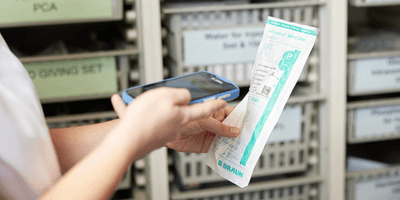
GS1 standards are used for the unique identification of every person, every product, and every place, to enable end-to-end traceability from manufacturer to patient.
Since our standards are both system and device agnostic, the data captured can then be shared seamlessly between systems and organisations to enable interoperability.
Mandated by The Department of Health and Social Care as part of the NHS eProcurement Strategy, the adoption of GS1 standards went on to be piloted as part of the Scan4Safety programme.
Traceability and interoperability
There are a series of GS1 Identification Keys that are used in healthcare to enable transparency throughout the supply chain and patient pathway. These keys allow for people, products and places to be identified seamlessly, in a standardised format, so that the data captured is consistent.
Our GS1 standards are also both system and device agnostic, allowing this vital data to then be shared between systems and organisations to facilitate system-wide interoperability.
Every month, we share updates on the latest GS1 standards news and developments from across the UK and internationally. Sign up for our newsletter below.
Common GS1 standards in healthcare

Global Service Relation Number (GSRN)
Identifies relationships between organisations and individuals, used in healthcare to uniquely identify patients, staff or service recipients.

Global Trade Item Number (GTIN)
Identifies products and medical devices at any packaging level, ensuring consistent identification for ordering, tracking and traceability.

Global Location Number (GLN)
Identifies healthcare organisations and physical or functional locations, such as hospitals, departments or wards.

Global Individual Asset Identifier (GIAI)
Identifies individual assets, such as medical equipment, enabling tracking, maintenance and lifecycle management.

Global Document Type Identifier (GDTI)
Identifies documents (physical or digital), such as clinical records, certificates or regulatory documentation.

Electronic Product Code Information Services (EPCIS)
A data-sharing standard that captures and shares event data (what, where, when and why) about products and assets, enabling end-to-end visibility and traceability across the healthcare supply chain.
Summary of key terms
To help you navigate the key terms, acronyms and definitions you may come across along the way, we have developed a handy guide which highlights the most significant ones you need to know.
Download the A-Z of healthcare terminology to gain a better understanding of the GS1 Identification Keys, their abbreviations, and where they fit into the supply chain and patient pathway.



The use cases


Scan4Safety
The Scan4Safety evidence report demonstrated that implementing GS1 standards improves patient safety, reduces unwarranted clinical variation, and drives operational efficiencies – delivering better quality and safety in healthcare.
of clinical time back to patient care
caused wrong patient, drug, dose and form
Product recall time reduced from 8.33 days to less than 35 minutes
Non-recurrent inventory reductions of £9m across the six demonstrator sites
Recurrent inventory savings worth nearly £5m across the six trusts
Cumulative benefits of £3,194,346 realised within two years at Derby
To learn more about Scan4Safety and its impact, download the full report via the link below.
GS1 UK's healthcare groups