
May 29, 2026 Industry news
The Medicines and Healthcare products Regulatory Agency (MHRA) have published the draft Medical Devices (Amendment) Regulations 2026 on the World Trade Organisation notification portal.
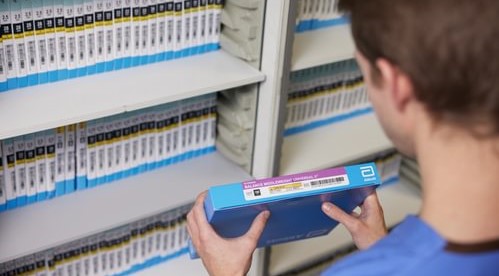
Clinician holding a medical device with a UDI label
The proposed changes are designed to “bring forward patient-centred and proportionate regulatory requirements to prioritise patient safety and access to innovative medical technologies”.
This proposal marks an important step for the regulation of medical devices on the GB market and is a critical measure to align key elements of GB regulation with existing international medical regulation. The proposed date of adoption is currently earmarked for December 2026, with entry into force anticipated in June 2027.
A summary of the key points can be found on the UK government website via the link below.
MHRA call for industry views
Stakeholders in the medtech industry, approved bodies, healthcare providers and patients are invited to share their views on the impact of the proposed changes. A link to complete the MHRA survey can be found below.
The survey will close on: Friday 19 June 2026 at 11:59pm (UK time).
A key point for UDI implementation
One detail of particular relevance to UDI implementation is the following:
- “(f) linear barcodes used in implantable medical devices must be concatenated and not separated in two or more barcodes, and all parts and elements of the linear barcode must be distinguishable and identifiable.”
This is important for two reasons:
- Mandatory concatenation means that the entire UDI string must be linked together into a single barcode
- Single barcode requirement means that relevant data must not be artificially separated into two or more barcodes on product packaging
One product, one barcode
Many medical device manufacturers and suppliers are increasingly opting to use the 2D GS1 DataMatrix as the preferred data carrier on products – a transition that will help to meet the proposed requirements.
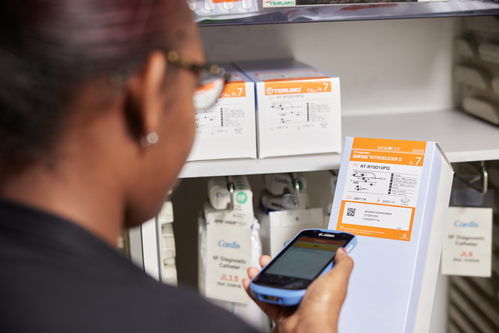
Person scanning a medical device with a GS1 2D DataMatrix barcode
Today, 40 per cent of medical devices carry a 2D GS1 DataMatrix, four times more than in 2018.
Three key benefits of using the 2D GS1 DataMatrix:
- More data in less space: it can encode identifiers such as GTIN, batch/lot number, serial number and expiry date in a compact symbol
- Supports UDI requirements: it is well suited to healthcare and medical device labelling where more detailed product identification is needed
- Works well on small items: useful for medical devices, healthcare products and packaging where label space is limited
As regulation continues to move towards stronger traceability requirements, compliance with UDI requirements for GB regulation will be critical for supporting consistency, interoperability and patient safety in healthcare.