August 07, 2026 Industry news
Since 1 January 2025, under the Windsor Framework, the use of 2D DataMatrix barcodes on medicines supplied to the UK market has become optional. As a result, barcode use on medicines packaging is becoming increasingly inconsistent, with some manufacturers removing 2D DataMatrix barcodes and other packs being supplied with missing, inaccurate or unscannable barcodes.
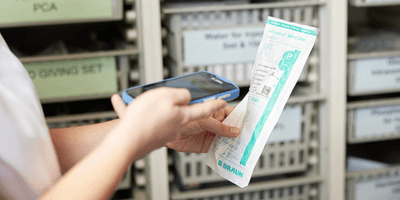
This is creating a growing patient safety and operational risk for NHS pharmacy services. Barcode scanning is now embedded across key medicines management workflows, including goods receipt, stock control, dispensing, automated drug cabinets, accuracy checking and closed-loop medicines management.
As more medicines enter the UK supply chain without reliable 2D DataMatrix barcodes, pharmacy teams are becoming increasingly reliant on manual workarounds. This adds avoidable workload, weakens the value of digital and automation investments, and creates unnecessary risk across medicines management.
Background
Under the former Falsified Medicines Directive (FMD), medicines packs were required to carry a 2D DataMatrix barcode containing key data elements such as the Global Trade Item Number (GTIN), batch number, expiry date and serialisation data, where applicable. This enabled pack-level identification and verification across the medicines supply chain.

Although FMD no longer applies in Great Britain following the UK’s departure from the EU, continued use of 2D DataMatrix barcodes remains essential for NHS pharmacy services.
These barcodes provide the data foundation for:
- End-to-end medicines traceability across the supply chain Safer and more efficient medicines administration
- Automated dispensing, storage and inventory management
- Closed-loop medicines management, including automated drug cabinets and pharmacy robots
- Medicines recalls, batch tracking and stock visibility
- Reduced reliance on manual processes
The impact is not limited to hospital pharmacy. It affects the wider medicines pathway, including wholesalers, distributors, community pharmacy, and other settings that rely on accurate product identification and traceability.
Assessment
The absence of reliable 2D DataMatrix barcodes is creating operational, patient safety and strategic risks across the medicines management pathway.
Operational impact
Missing, inaccurate or unscannable barcodes disrupt routine and automated pharmacy processes, including:
- Goods receipt and stock management
- Automated storage and retrieval systems
- Robotic dispensing systems
- Hub-and-spoke dispensing models
- Accuracy checking and final product verification
- Medicines product recall and batch tracking processes
Where barcode scanning fails, pharmacy teams must manually identify, record and verify medicines. This increases workload, slows operational processes and reduces the intended benefits of national investment in digital pharmacy infrastructure.

Patient safety impact
Barcodes are essential for closed-loop medicines administration, enabling medicines to be scanned and checked against the patient and prescription at the point of care.
Missing or unreliable barcodes prevent clinical staff from realising the secondary validation benefits that digital systems can provide, including support for the five rights of medicine administration: right patient, right medicine, right dose, right route and right time.
This increases reliance on manual checking, reduces the safety benefits of point-of-care scanning and may weaken safeguards designed to prevent medicines administration errors.
Strategic impact
The removal of 2D DataMatrix barcodes risks undermining national ambitions to move from analogue to digital. It creates a disconnect between policy ambitions for automation, interoperability and traceability, and the practical data standards required to deliver them.
Without a consistent requirement for 2D DataMatrix barcodes on UK medicines packaging, NHS organisations may face increasing variation in the quality and availability of barcode data. This could constrain the scalable adoption of digital medicines systems and reduce confidence in automation.
Evidence on the scale and severity of impact
GS1 UK conducted a survey between March and April 2026 to assess the impact of missing or unreadable barcodes on NHS Trusts.
44 secondary care organisations responded to the survey. Most respondents came from acute NHS trusts, alongside responses from mental health and specialist services. Although the survey was open to organisations across the UK, the majority of responses received were from organisations in England.
The findings show that barcode quality issues are already affecting pharmacy workflows, with 57 per cent of respondents reporting a moderate to severe impact on pharmacy services and operational workflows.
While 73 per cent of respondents reported using dispensing robots, only 44 per cent scanned medicines at receipt and 25 per cent at dispensing. This suggests a gap between the availability of digital infrastructure and its routine operational use.
A coordinated national response is needed to protect patient safety, maintain medicines traceability and support the continued adoption of digital systems across the NHS.

Reported barcode quality issues were widely reported across responding organisations:
- 64 per cent of respondents had received medicines without barcodes in the previous month, with affected packs ranging from 1 to more than 150. The most common range was 1–50 packs, reported by 41 per cent of respondents in this category
- 46 per cent of respondents had received medicines with unscannable barcodes in the previous month, with affected packs ranging from 1 to more than 20
- 25 per cent of respondents had received medicines with incorrect or mismatched barcodes in the previous month, with affected packs ranging from 1 to 10
Taken together, the findings suggest that more than half of responding organisations are experiencing moderate to severe workflow disruption linked to missing, incomplete or inaccurate barcodes.
Qualitative responses highlighted three recurring themes: patient safety risks resulting from workarounds; operational inefficiencies affecting robot dispensing and stock management; and barriers to implementing end-to-end closed-loop medicines management. Organisations using dispensing robots reported greater impact, reflecting their reliance on barcode functionality.
Further evidence from a health technology provider showed that between 1 January and 31 May 2026, 23,752 product barcodes were scanned using the RxWeb PMR system, of which 38 per cent did not return a product match.
NHS England Pharmacy and the GS1 standards team have also undertaken a survey on the patient safety impact of missing barcode. Results are expected to be published late 2026 and early 2027.
Recommendation
The national barcode consultation announced by DHSC and MHRA provides an opportunity to establish clear requirements for medicines packaging and ensure that barcode standards support safe, efficient and interoperable medicines management.
These recommendations are informed by the survey findings and reflect the themes raised by responding organisations.
Recommendations are:
Maintain 2D DataMatrix barcodes on UK medicines packaging during the policy review period
Manufacturers and marketing authorisation holders should continue to include 2D DataMatrix barcodes voluntarily while future regulatory requirements are considered.
Establish clear regulatory requirements for barcode use
Government and regulators should consider mandating 2D DataMatrix barcodes on UK medicines packaging to support traceability, automation and safer medicines use.
Core data should include, as a minimum, the GTIN, batch number and expiry date, with serialisation data included where appropriate.
Strengthen national reporting and monitoring of barcode issues
NHS organisations should be encouraged to report missing, inaccurate and unscannable barcode issues through established routes. GS1 UK has created a reporting form for barcode or data errors affecting pharmaceutical products.
Reporting should be used to identify recurring issues, support engagement with manufacturers and inform regulatory discussions.
Use the emerging evidence base to inform national policy
Findings from GS1 UK, NHS England, solution providers and pharmacy networks should be brought together to provide a clear national picture of the impact on pharmacy services, patient safety and digital medicines infrastructure.
Maintain cross-sector engagement on medicines barcode standards
Ongoing collaboration is needed between NHS organisations, regulators, professional bodies, trade assciations, wholesalers, distributors, manufacturers and standards bodies to support a consistent national approach.

Reliable barcode data underpins medicines traceability, patient safety and the effective use of digital pharmacy systems.
As NHS organisations continue to invest in automation and closed-loop medicines management, maintaining consistent barcode standards across medicines packaging will become increasingly important.
The findings in this survey suggest that action is needed to ensure investments in digital transformation deliver their intended benefits for patients, healthcare professionals and the wider health system.