The apparel industry is changing fast
Sustainability regulation is tightening, consumers are demanding transparency and retailers expect accurate, consistent product data across every channel.
GS1 standards give brands, retailers and supply chain partners the shared language to meet these pressures — and to prepare for the mandatory Digital Product Passport requirements coming into force from 2027.
Why GS1 matters in apparel
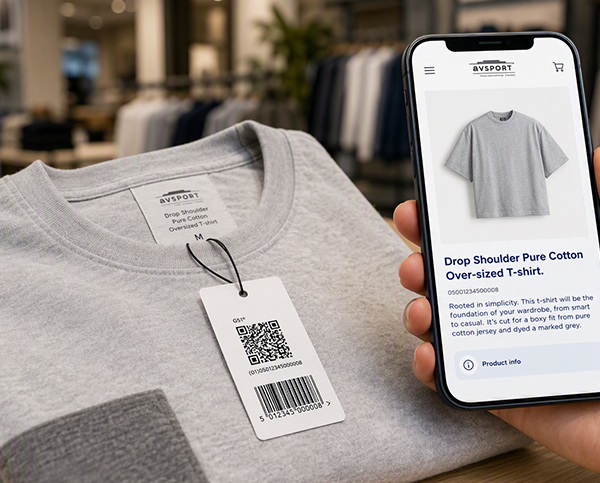
A single jacket style can exist in dozens of sizes, colour and fit combinations. Each one needs to be uniquely identified, accurately described and reliably tracked — from the factory floor to the fitting room and back again if returned.
Without a shared system of identification, that complexity breeds errors: wrong sizes shipped, inaccurate listings, missed sustainability obligations and limited access to the trusted product information needed to support resale, repair and recycling.
GS1 standards solve this at the root. By giving every product, location and shipment a globally unique identifier, they create a single source of truth that works across every system, every trading partner and every market.
The challenges facing apparel today
Multi-tier production across global manufacturing networks creates visibility gaps. Without shared identifiers, tracking a garment from mill to shelf is a patchwork of manual reconciliation and mismatched data.
Shoppers expect real-time availability online and in store. Poor product identification leads to overselling, phantom stock and lost sales — across every channel simultaneously.
Up to 30 per cent of online clothing returns are linked to inaccurate product information. Size, colour and material inconsistencies in listings drive avoidable returns that erode margins and sustainability targets.
Regulators, investors and consumers are demanding verified transparency on materials, manufacturing conditions and environmental impact. That requires robust, persistent identifiers from fibre to finished product.
From 2027, the EU's Ecodesign for Sustainable Products Regulation (ESPR) will require apparel brands selling into EU markets to provide a machine-readable Digital Product Passport (DPP) for each product — containing verified data on origins, materials, repairability and end-of-life options. GS1 standards are the foundation that makes this possible.
AI shopping agents — acting autonomously on behalf of consumers to discover, compare and purchase products — are changing the rules of retail visibility. These agents don't browse like humans; they query structured product data and brands that can't serve machine-readable, GS1-compliant product information simply won't be found.
As agentic commerce scales across platforms like Google, Amazon and emerging AI assistants, clean and standardised product data stops being a back-office concern and becomes a front-line commercial requirement.
The same product may be manufactured across multiple countries or switch suppliers between seasons. While items share the same SKU or GTIN, differences in country of origin can expose them to different tariffs. Without clear origin data, brands lack the visibility to allocate stock efficiently — driving unnecessary costs and margin pressure.
What GS1 standards do in apparel
The essential foundation that keeps every garment identified, every data point trusted and every channel connected.

Global Trade Item Number (GTIN)
Uniquely identifies every product variant — style, size, colour, fit — linking the physical garment to its digital identity.

Barcodes (EAN)
The physical barcode printed on garment labels and swing tags, encoding the GTIN for scanning at point of sale, in stockrooms and at every point in the supply chain. The EAN-13 is the standard format for apparel.

Global Location Number (GLN)
Identifies every supplier, factory, warehouse and logistics partner consistently across the supply chain.

Global Model Number (GMN)
Links every variation of a garment back to a single product model, giving brands a clear view of product families. Enables traceability, supports circular business models like resale and repair.

QR codes powered by GS1
The consumer-facing access point to product information and the Digital Product Passport — scannable anywhere, linked to rich digital content.

GS1 Digital Link
Connects physical products to dynamic digital content — particularly valuable for small labels and high-value items.

RFID
Enables item-level visibility and hands-free tracking at scale, supporting inventory management and circular business models.

GS1 Web Vocabulary
Machine-readable, standardised product data that enables AI-driven discovery and consistent sharing across digital platforms.

GS1 EPCIS
Captures and shares trusted event data — movements, transformations, authentications — across the supply chain and product lifecycle.
What this means for your business
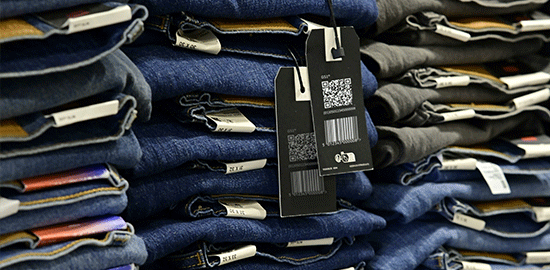
Assign a GTIN and barcode to every size, colour and fit variant and you eliminate the ambiguity that drives returns, portal rejections and picking errors. Adopt QR codes powered by GS1 and you have a single scannable link to your Digital Product Passport, care instructions, sustainability credentials and brand story — on the label, ready for 2027.
Major UK retailers including John Lewis, ASOS and Next already mandate GS1-compliant product data from their suppliers. Getting compliant now is a commercial advantage, not just a regulatory obligation.

When your suppliers use GS1 standards, ranging new product becomes faster, stock accuracy improves, and the authenticated sustainability data your customers are asking for is available at the point of purchase.
Serialised GS1 identifiers also help remove counterfeit goods from your assortment — a growing problem in UK fashion.

Access verified composition data at the point of sorting — fibres, finishes, chemical compliance — without relying on the brand to provide it manually.
GS1 EPCIS event data supports more efficient reuse, better sorting outcomes, and compliance with Extended Producer Responsibility (EPR) obligations.

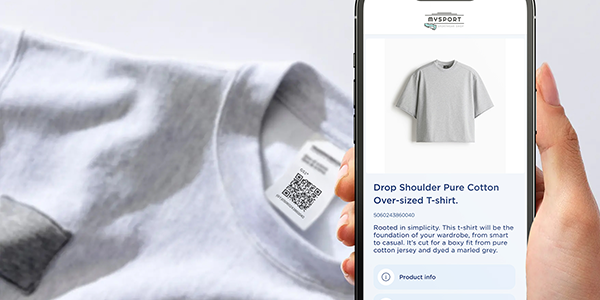
A QR code on a garment label becomes a window into its story: where it was made, what it contains, how to care for it, and what to do with it at end of life.
Consumers can make genuinely informed purchasing decisions, participate in takeback schemes and resell with confidence.
Digital Product Passports (DPP): what apparel brands need to know now
The Digital Product Passport is a standardised, machine-readable digital record containing verified data about a garment's full lifecycle — materials, origins, environmental indicators, chemical compliance, repairability and end-of-life guidance.
It will be accessed by consumers, retailers, recyclers and regulators through a QR code on the product label. And it will be mandatory for apparel sold in EU markets.
GS1 standards — GTINs, GLNs, QR codes, EPCIS and GS1 Digital Link — are the identification and data-sharing infrastructure that DPP ecosystems are being built on. Brands that adopt them now are building compliance readiness alongside commercial capability.
What to do next




GS1 standards in action


Esska Shoes — 3,500 Digital Product Passports in under two days
Working with GS1 UK partner, Buyerdock, Esska Shoes used GS1 standards to create more than 3,500 Digital Product Passports at speed — demonstrating that DPP compliance at scale is achievable today.