
Scan4Safety uses GS1 standards and barcode scanning to uniquely identify people, products and places.
Scanning at the point of care helps staff verify that the right patient is receiving the right product or treatment. It also creates an accurate digital record of what was used, where, when and for whom.
This can help flag potential errors before they reach patients, stop expired or incompatible products being used and quickly identify affected patients and products during a recall.
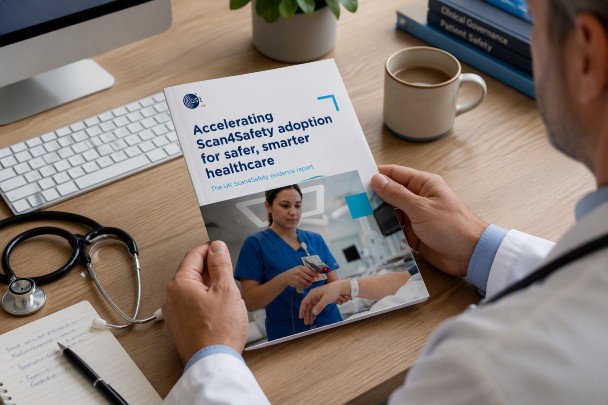
Ten years after Scan4Safety was launched, the evidence is broader and stronger than ever.
Our new independent report, developed in collaboration with the The PSC, brings together research involving healthcare organisations and stakeholders across the UK and Ireland, international case studies and analysis of national cost data.
The findings show consistent patient safety, productivity and financial benefits where Scan4Safety has become part of everyday clinical and operational practice. But adoption remains uneven and many of these benefits are still not being realised across the health system.
Key findings
incorrect patient identity band scans flagged before medicine administration over two years at one hospital
returned to one emergency department each week, equivalent to the working time of four full-time nurses
reduction in the time taken to identify patients affected by one product recall
captured in savings across the first 19 providers in NHS Supply Chain’s inventory management system programme
The opportunity ahead
The report models what could happen if 32 trusts with lower levels of maturity in the areas examined introduced inventory management systems and point of care scanning in operating theatres and medical device storerooms.
It estimates that this could prevent 20 to 36 Never Events each year, deliver £49m in recurrent productivity gains and generate £34m in one-off savings.
These estimates are based on conservative modelling and are not guaranteed outcomes.

The NHS contains outstanding practice, but too often that practice is not applied consistently enough across the system. The challenge is not a lack of good practice. It is unwarranted variation.”
Lord Carter of Coles
Patrick Robert Carter, current member of the House of Lords