
DRS products require new GTINs
 The industry-led organisation delivering the Deposit Return Scheme (DRS), Exchange for Change, have confirmed that "all existing product barcodes will need to be changed". This means that a dedicated specific barcode needs to be applied to all in-scope containers placed on the DRS market. In GS1 terms, this means that eligible products will require new Global Trade Item Numbers (GTIN) and barcodes.
This is because deposit-bearing products must be distinguishable from pre-scheme (legacy) stock throughout retail, supply chain and scheme systems.
Importantly, businesses should not stop at the individual item. Whenever a GTIN changes, the impact on related packaging levels should also be reviewed in line with the GS1 GTIN Management Standard.
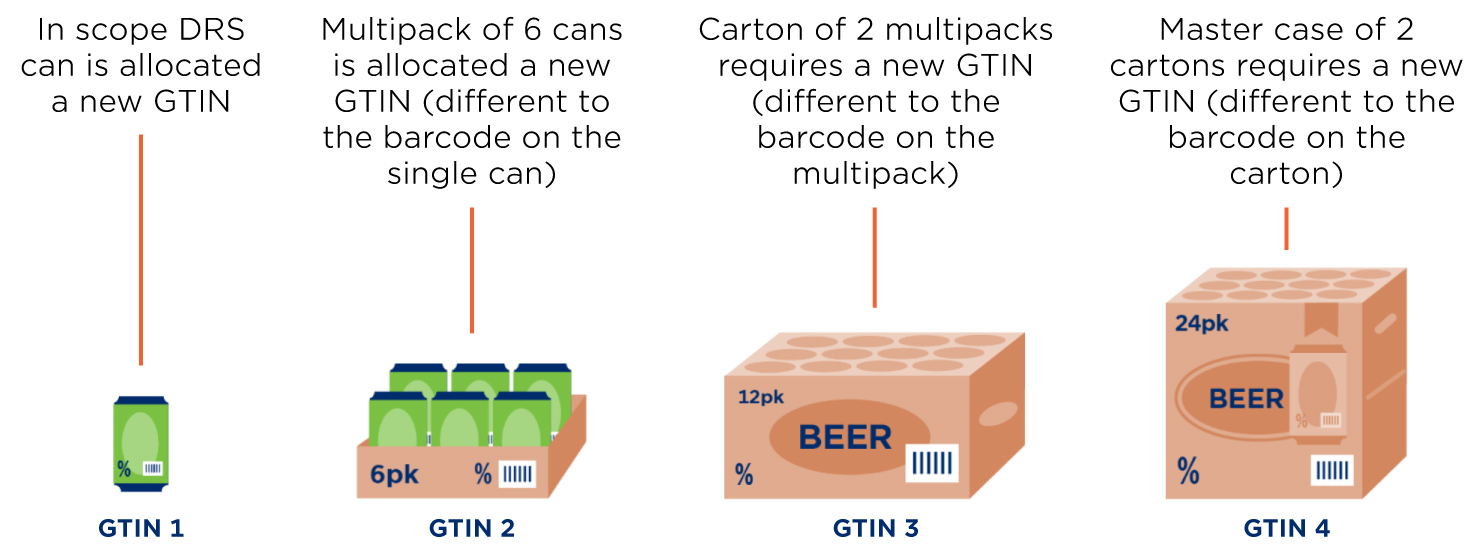
This is not a new rule specific to DRS - it is simply the normal application of the GS1 GTIN Management Standard.
For more information on product identification and when product or packaging changes require a new barcode, see:
Why multipacks are different under DRS
Exchange for Change has confirmed that individual containers within a multipack must be identifiable so they can be recognised by reverse vending machines (RVMs), other return points, counting centres and scheme systems when returned.
As a result, the outer multipack and the individual containers must have different product identifiers.
This means many businesses that previously did not identify individual multipack components will need to review their approach before DRS goes live.
Example: a six-pack of soft drinks
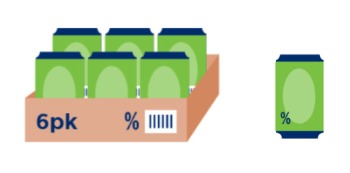
Before DRS:
- Six-pack sold as a single retail item
- Six-pack carries its own barcode and GTIN
- Individual not individually identified
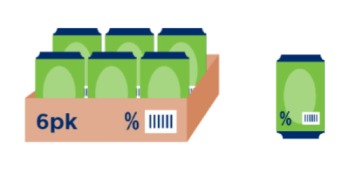
After DRS:
- Each can requires its own GTIN and barcode
- The six-pack requires a different GTIN from the individual cans
- The six-pack barcode is used to sell the product at retail
- Individual can identifiers enable recognition and deposit refund processes when containers are returned individually
What about "not for sale" multiple items?
This is one of the areas generating the most questions from producers.
Historically, many brands have marked individual multipack items as "not for individual sale" and either omitted a retail barcode or used alternative approaches to discourage separate sale.
Under DRS, the position is clear: if the individual container needs to be recognised and refunded through the scheme, it must have its own identifier. Producers therefore have to allocate a separate GTIN to the individual container, even where it is only intended to be sold as part of a multipack.
Where GS1 standards stop
It is important to distinguish between what is a standards requirement and what is an operational or industry decision. GS1 standards do not determine:
Whether retailers allow individual sale of multipack items
How point-of-sale systems handle items marked as "not for sale"
Whether additional controls are introduced to prevent separate sale
How the DMO or retailers choose to operationalise multipack components within the scheme
Phasing guidance for sell-through of non-compliant stock ahead of October 2027 go live
What producers should do now
To prepare for DRS:
Identify all in-scope products requiring DRS registration
Allocate new GTINs for DRS products, including all outer packaging used in the supply chain, multipack outers and multipack individual items
Build barcode and packaging changes into artwork and production plans early
Assess the opportunity of implementing QR code powered by GS1 on container artwork at the same time
Monitor guidance from Exchange for Change as further operational detail becomes available