
Variations of EAN
EAN terminology has carried across to several GS1 standards, examples of which can be found below.
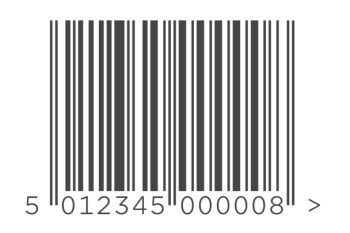
GTIN-13 (formerly EAN-13)
EAN-13 is the barcode symbol that encodes the GTIN-13 number. It’s the familiar barcode seen on retail packaging: black and white bars of varying width. This is a point-of-sale barcode designed to be scanned at the till to identify the product.
The 13 digits are derived from your GS1 Company Prefix followed by your product reference digits and ending with a check digit.
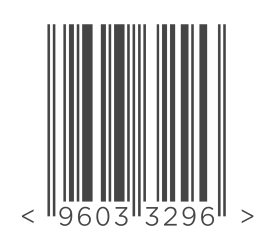
GTIN-8 (EAN-8)
GTIN-8 numbers can be used to identify small consumer items where you’d struggle to fit an EAN-13 barcode at its minimum size. These GTIN-8 numbers are encoded in smaller EAN-8 barcodes.
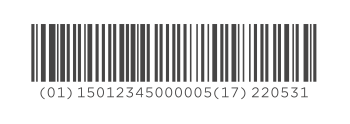
GS1-128 (formerly EAN-128)
EAN-128 was the original name for the GS1-128 ,a barcode type used in logistics and supply chains rather than at the point of sale.
Where EAN-13 encodes just one piece of information (product identifier) GS1-128 can encode many types of data in a single barcode: batch numbers, expiry dates, quantities, and more.
GS1-128 is found on case labels, shipping labels and pallet labels rather than on consumer-facing products. Some suppliers may still refer to GS1-128 as EAN-128, so it’s worth knowing that the two names refer to the same standard.
How EANs / GTIN-13s work
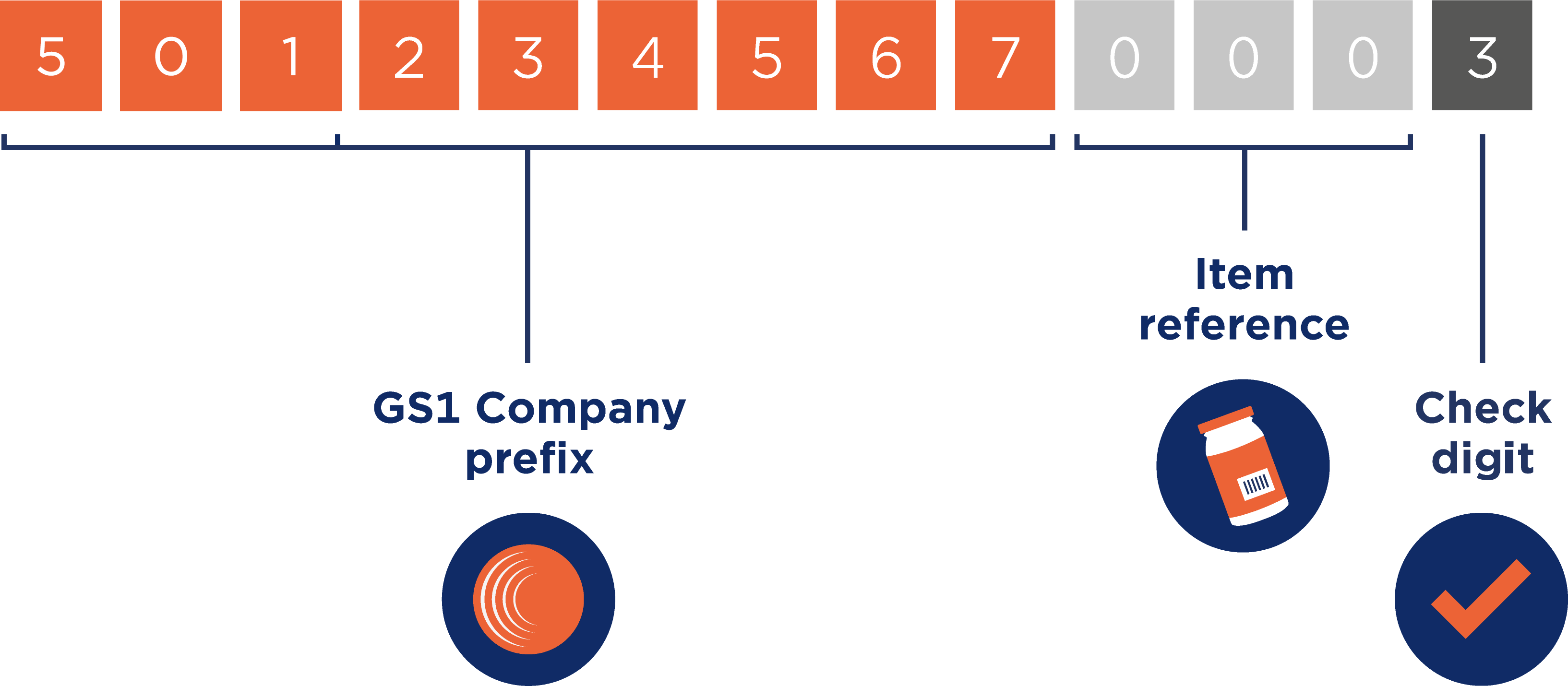
An EAN (GTIN-13) is a structured 13-digit number. It is not a random sequence, as it may initially appear.
There are three components:

Digits from your GS1 Company Prefix
The digits from your GS1 Company Prefix is a unique identifier for your company, issued by GS1 UK, that forms the basis of all your GS1 identifiers

Digits from your product reference
The digits from your product reference are assigned by you to uniquely identify each product in your range

Final check digit
A final check digit is mathematically calculated to validate the previous numbers in the string and catch scanning errors if incorrect
Because no two companies can share a GS1 Company Prefix, all GTIN-13s are unique. When the GTIN-13 is encoded into an EAN-13 barcode, any compliant scanner can read the barcode.
Benefits of EANs / GTINs
GS1 numbers and barcodes carry many benefits for retailers and consumers alike:
You can sell through retail and online marketplaces: the majority of online ecommerce platforms require valid GTINs to list products, meaning that without one you can’t sell your products
You have a globally unique product entity: your GTIN is yours, traceable to a specific product and your company whilst you maintain your GS1 membership
You can pass retailer and marketplace validation: GTINs issued via GS1 UK are registered in a global database, Verified by GS1, allowing validation that third-party barcodes frequently fail
You have a foundation for your supply chain: GTINs can be used in different barcode types across point-of-sale items, cases and shippers, meaning the numbers are understood consistently throughout the entire supply chain
You’re future-proofed: as QR codes powered by GS1 become the next generation of product barcodes, your GTIN will remain at their core
How to get an EAN / GTIN
Authorised GTINs must be obtained from an official GS1 Member Organisation, and in the UK that is GS1 UK. While third-party sellers sometimes offer EAN barcodes at low cost, these are not guaranteed to be unique, are not globally traceable back to your business and will likely fail validation checks, leading to your products being rejected.
The process to get GTINs is simple:
Join GS1 UK - our membership fees are based on your annual turnover
Receive your GS1 Company Prefix
Assign a unique GTIN to each of your different products in your dedicated Numberbank
Create your EAN-13 barcodes at no extra cost
Share your products in My Numberbank on Verified by GS1 for global visibility
Get your EAN from GS1 UK
EANs or GTINs are the foundation of your retail product identity and getting one that is correctly issued and valid is a crucial first step for any business wanting to sell products through retail or online marketplaces.
Whether you’re launching your first product or expanding an existing range, you can get a GS1 Company Prefix from GS1 UK. From here you can register products and create barcodes for all variations of your products, ready to be verified and identified anywhere in the world.
EAN FAQs
EAN stands for European Article Number, the original name for what is now referred to as a GTIN (Global Trade Item Number). The name changed when the standard moved from European-specific to global.
In everyday use yes, but technically the number and the barcode are different components. If someone asks for your EAN number or EAN code they most likely want the GTIN.
For major global marketplaces like Amazon, eBay, Google Shopping and similar, the answer is yes. You require a valid GTIN to list physical products for sale.
Without a GTIN your product range may be rejected or suppressed. These marketplaces verify legitimate use of GTINs with GS1, meaning that third-party issued barcodes often fail validation checks.
Yes, each distinct variation needs a unique GTIN. Variations count as distinct if a retailer or customer need to distinguish between product types - things like flavour, colour, quantity, size and so on.