

April 30, 2026 Industry news
The Department of Health and Social Care (DHSC) and NHS England issue a formal response on behalf of the government to evidence highlighted in the House of Lords report.
The role of the UK government in medicines supply
Due to the complex nature of the medicines supply chain, the government’s position remains refined to key remits such as:
- Delivering security through risk management: identifying and mitigating potential risks to the continuity of medicines supply
- Building resilience: preparedness for potential incidents that may disrupt supply (such as a global pandemic) and implementing holistic measures to manage demand such as buffer-stock requirements and approaches to value-based procurement
- Implementing measures for when demand exceeds supply: sourcing alternative options and issuing substitution guidance to safeguard patient care
The scale of the problem. Why now?
The House of Lords Public Services Committee report, Medicines security – a national priority, came amid growing industry concerns about medicines supply and supply chain security following increasing reports of shortages across the UK.
One example of evidence highlighted in the report stated, “The number of supply disruptions reported by pharmaceutical suppliers to DHSC has increased, from under 1,000 in 2021,61 to around 1,600 notifications per year from suppliers in 2022 and 2023, to over 1,900 in 2024, though the DHSC noted that 2025 had seen a return to 2022 levels”.

For the systems that the government owns, there is work underway to support wider access to information about current supply issues, including the medicine supply tool which provides live national shortage information for healthcare professionals. The government is also developing digital pathways to enable GP prescribing systems to flag shortages at the point of prescribing.
In the immediate term, levels of medicines shortages appear to be improving however, the Lords report advocated for increased supply chain digitalisation to further support improvements and to facilitate the critical sharing of live information.
Recognising the demand for greater visibility and the use of 2D barcodes
In response to the report’s recommendation for improved digitalisation, the government argues that both efficiency and security depend on accurate, timely information. However, it emphasised that comprehensive, mandatory, real-time reporting is challenging in a commercially sensitive, multi-stakeholder market.
It also acknowledges the demand for real-time stock visibility across the supply chain adding: “the DHSC is already progressing a range of measures to strengthen its understanding of supply chain pressures (recommendation 92). As noted to the Committee [Public Services Committee], manufacturers are legally required to report potential supply issues at least six months in advance where possible, and DHSC is reviewing enforcement mechanisms to improve compliance and timeliness. This is a critical tool in the department identifying supply issues early and maximising the time to respond.”
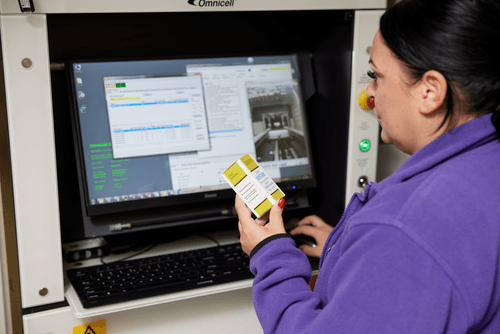
Through standardised product identification, it becomes easier to identify, track and trace products. When this unique and accurate product data is encoded into a 2D barcode, it can then be captured seamlessly, through scanning at the point of care or use, to be shared with multiple systems and stakeholders – capture once, share to many.
The committee noted the benefits of 2D barcodes on pack and have made calls for the government to mandate their use across the medicines supply chain. The government plans to consult on the types and use of barcodes that might be needed on medicine packs.
Why use the GS1 2D DataMatrix?
GS1 standards are based on the accurate and unique idenfication, capture and sharing of information on a standardised format to promote consistency.
- Consistent identification: common identifiers reduce ambiguity when shortages drive substitutions or emergency sourcing
- Consistent capture: shared rules for what a 2D barcode encodes make automation (batch/expiry/serial where used) reliable
- Consistent sharing: standards reduce friction when data must be shared between trading partners and NHS/regulatory systems to support interoperability
With capturing pack-level data, there is an opportunity to build a more robust infrastructure for better visibility and valuable insights for operational decisions.

- Security improvements: supports authenticity checks and faster identification/quarantine of affected stock during defects and recalls
- Greater efficiency: barcode scanning reduces manual data entry, improves stock accuracy and enables faster inventory decisions
- Reliable workflows: improves substitution and shortage management when systems can better distinguish between products and interpret pack data consistently
- Targeted stock observations: seasonal/winter monitoring using any supplied stock data for selected medicines, compared with demand trends
- Better tools information for clinicians: monitor stock levels to incorporate into national shortage tools and flags in GP prescribing systems
For stakeholders this means:
- Manufacturers/Marketing authorisation holders (MAHs): ensure scan quality and data accuracy, linking packaging identifiers to trusted master data so scans resolve correctly
- Wholesalers: scan at receipt and despatch to improve accuracy, first expired first out (FEFO) allocation and faster quarantine/recall responses
- NHS providers: use scanning to reduce manual entry, support safer dispensing and administration, improve inventory accuracy and speed up recalls processes
- Regulators/policymakers: specify the minimum data requirements and conformance expectations for relevant stakeholders (including requirements for system and scanner readiness)
Next steps
To follow, the government plans to publish a public consultation into the use of 2D barcodes and intends to set out further actions to strengthen the resilience of UK medicines supply chains.
When the consultation is launched, we will share more information via our healthcare newsletter. Sign up via the link below to stay up to date.