May 28, 2026 Guest opinion piece
NHS digitisation is firmly on the agenda, with the government’s 10 Year Health Plan placing renewed focus on data, productivity and safer care.
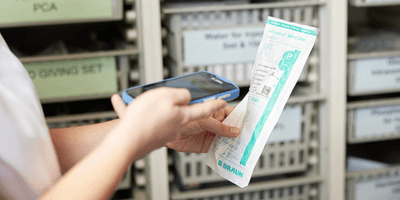
Scan4Safety is the NHS approach to using barcode scanning and data standards to link people (patients and staff), products and places, creating accurate records at the point of care.
We sat down with Dr Nnenna Osuji, chief executive of NHS North East London ICB, to talk about what that looks like in practice, from traceability and recall readiness to real time visibility that can improve patient flow, and the foundations needed for safe digital transformation, including AI.
Patient safety and prevention
Scan4Safety is often associated with prevention so how does traceability prevent avoidable harm, particularly in areas such as implants and mesh procedures?
This is one of the most challenging but critical benefits of Scan4Safety to articulate because people want to monetise benefits quickly and visibly, often within a single financial year. Many patient safety benefits are not immediately visible but the arc of saving over time is significant.
Take mesh or implant scandals. You can’t directly or immediately see the harm of a patient who has an implant but isn’t aware of it. You can’t see the harm when organisations don’t know which patients are affected because systems can’t track or trace accurately. You can’t see the future legal costs or the moral injury experienced by staff when recalls can’t be completed properly.
These safety benefits may be less visible, but they are deeply impactful, financially, clinically and ethically. Scan4Safety, by automating traceability, creates an extensive ripple effect, providing invaluable benefits to both staff and patients.
Urgent and emergency care pathways
How can GS1 standards transform patient flow, traceability and clinical decision making across urgent and emergency care pathways?
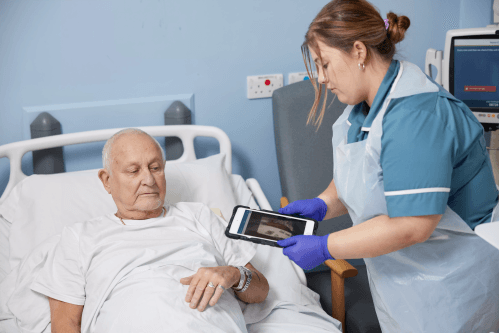
If we get this right, it would be transformational. Real time visibility of where patients are, without relying on multiple handovers, allows better resource planning and smoother flow.
Extending this beyond hospital walls enables predictive decision making before patients even arrive, reducing crowding and corridor care. It also supports discharge planning by better ensuring care packages are available when and where needed. Fundamentally, real time visibility reduces waste in effort and enhances efficiency of flow.
But it comes back to basics. For Scan4Safety to reap benefits we need to ensure our fundamentals are in place: GS1 compliant wristbands, consistent use of the NHS number and a single language of data standards that connects the entire patient journey across systems and organisations.
Blood transfusion and the Infected Blood Inquiry
How can GS1 standards support national blood traceability in light of the Infected Blood Inquiry?
The findings of the Infected Blood Inquiry are deeply tragic. Safety systems have thankfully matured, but supply and demand remain major challenges.
GS1 standards and ICCBBA (International Council for Commonality in Blood Banking Automation) work in tandem to support the tracking of blood products, enabling greater traceability from donor to patient. That level of fidelity and automation is fundamentally game changing for blood and blood product safety.
Blood is an invaluable and scarce resource. Being able to track blood products, knowing where it is and which patient it is administered to, is critical. Information is our greatest currency.
Productivity, savings and the economic climate
Where do you see the greatest opportunity for Scan4Safety to improve productivity and financial efficiency across London?
There are opportunities everywhere. At its simplest, Scan4Safety reduces manual data entry, for example, automatically populating medical device registries at the point of scan. That releases staff time to focus on care delivery and reducing waiting lists.
Inventory management, a component of Scan4Safety, is another major opportunity. Better visibility means reduced waste, lower stockholding, fewer expired products and fewer cancelled procedures due to missing equipment. That delivers both one off financial benefits and ongoing efficiency gains.
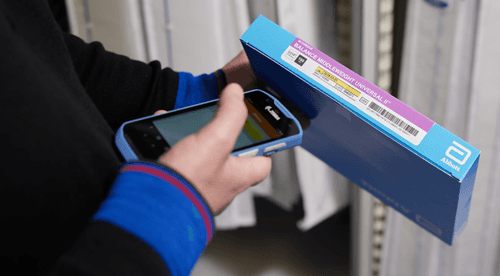
You also reduce staff time documenting procedures and completing safety checks, while achieving greater reliability. And once you have high quality data, you can objectively identify unwarranted variation, within organisations and across systems. That helps benchmark performance, narrow disparities and improve overall productivity.
Dispatching this opportunity across ICS acute provider footprints has proven invaluable in determining and comparing patient level costing data to optimise procedure costs across the patch, as well as identifying and reducing instances of unwarranted variation.
My ambition is that London, as a digitally committed region, becomes a digital exemplar, demonstrating what end to end scanning can achieve. This is not just for medical devices, but across patients, medicines, blood tracking and patient flow.
Done properly, Scan4Safety delivers safety, productivity and savings simultaneously. It truly ticks every box.
Scan4Safety and the 10 Year Health Plan
Looking ahead to the NHS long term digital ambitions, why is Scan4Safety foundational to delivering the 10 Year Health Plan? How does GS1 enabled traceability support that vision?
There are a couple of key elements in the 10 Year Health Plan. While there is rightly a strong digital focus, productivity is also critical. We talk about moving from analogue to digital but the worst thing we could do is simply digitise poor processes because rubbish in still equals rubbish out.
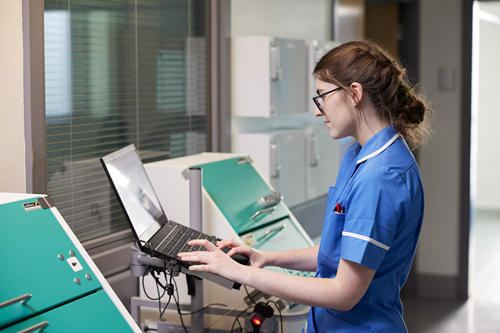
There is a real opportunity to be accurate about what we put into digital systems so that decisions are informed, correct and reliable. That’s where Scan4Safety comes in. By using unique identifiers for people, processes and consumables, we gain much greater clarity, accuracy and precision.
Doing this in real time isn’t just a digital benefit, it’s a productivity benefit. It reduces the manual effort required to collect data and minimises transcription risk when information moves between systems. Scan4Safety is fundamental to making the digital leap safely.
People get excited about technologies like AI, but without high quality, structured data, large language models will produce inaccurate, and potentially harmful, results.
Getting the basics right before innovation
In a landscape often captivated by innovation, why must the NHS prioritise foundational capabilities such as GS1 standards and accurate patient and location identification before scaling digital transformation?
Much of this builds on the previous answer. I remember being involved in the introduction of electronic chemotherapy prescribing systems. It was absolutely the right thing to do for safety, but it was only ever as good as the data we put into it.
We reduced some risks but inadvertently created potential others. Once a system is digitised, errors can propagate at speed if inputs are wrong. Whilst risk is reduced, hazards when things go wrong are increased. That same principle applies to all digital solutions.
Unless the raw materials, the inputs, are accurate and precise, there is a real risk that the outputs become harmful. Strong foundations as provided by global standards are not optional, they are essential.
Beyond the acute sector
How can Scan4Safety and GS1 standards extend into community settings, such as cancer pathways, medicines optimisation and blood traceability?
Blood is particularly close to my heart. It’s a scarce resource, especially for certain blood groups. Real time visibility allows much more nuanced matching of supply and demand, reducing wastage and improving safety.
However, cancer pathways and medicines optimisation are often still seen in the acute sector as benefits but there are huge opportunities outside hospital walls. Community settings involve high volume, lower cost consumables, but savings often sit in the margins.
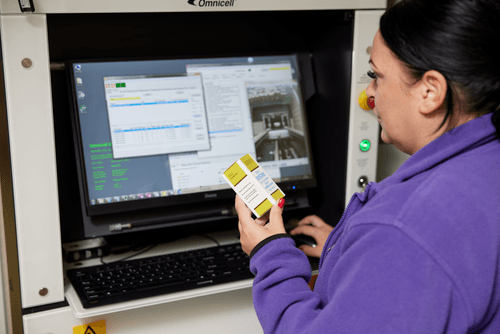
Take the cancer pathway for example, there are expensive devices and equipment used in the community, which we often duplicate or lose track of. Better traceability reduces waste and ensures availability when patients need it.
Medicines optimisation is an obvious use case, but when we look at the opportunity for Scan4Safety, we often talk about it from an organisational perspective. The patient perspective provides an exciting opportunity.
There is huge potential to link product identification to patient friendly information if patients can scan product information from their smartphones at home. Patient information can be better translated appropriately, with more digestible resources to enable better patient understanding, engagement and adherence. Opportunities such as this could reduce the overall health burden and misinformation.
Enabling the next wave of transformation
How does Scan4Safety support broader transformation initiatives, including AI and automation?
I’m impressed by and grateful for NHS Supply Chain’s approach to rolling out inventory management. NHS Supply Chain have supported 19 NHS trusts in England to implement inventory management systems in 10 specialities and already £15.34m in savings has been delivered in 2025/26 with the potential to save an average of 700 hours of clinical time per trust.
Once that baseline exists, it makes absolute sense to introduce and integrate Scan4Safety to maximise benefits in safety, productivity and efficiency.
The critical thing with AI is to ensure we are not introducing it for the sake of it, but to ensure it is addressing a real problem. This works best if data is accurate and captured in real time. Theatre productivity is a good example. AI can support optimisation, but only if foundational data standards are in place. Scan4Safety is that foundation.