
What is a Global Individual Asset Identifier?
A Global Individual Asset Identifier (GIAI) is a globally unique identifier used to identify individual assets within an organisation or across the supply chain.
GIAIs provide a reliable way to uniquely identify any specific asset (owned, leased, rented) for its entire life cycle, helping organisations maintain and share accurate asset records and improve visibility, control, and accountability.
What is it used for?
GIAIs are suitable for identifying individually managed assets, particularly those that need to be tracked, maintained, or audited over time, such as:
- Construction tools and equipment
- Machinery and plant assets
- IT equipment (such as laptops or tablets)
- Safety equipment
- Fixed or high-value assets
They allow organisations to identify and manage each specific asset, supporting asset registers, servicing and compliance processes.
Structure of a GIAI
The GIAI is an alphanumeric code of up to 30 characters, and is structured as follows:
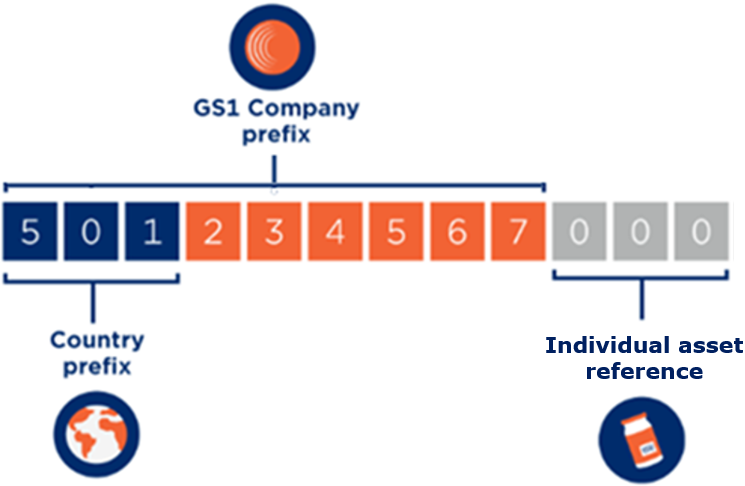
GS1 Company Prefix (GCP) – a unique number allocated by GS1 organisations, used to create globally unique identifiers. It is the same prefix provided as part of GS1 UK membership and ensures identifiers are unique worldwide.
Individual asset reference – uniquely identifies the individual asset within the organisation’s asset numbering system and can be numeric or alphanumeric.
Together, these elements ensure that each asset is globally unique and can be reliably identified wherever it is used.
Tip: The length of the GS1 Company Prefix varies based on an organisation’s numbering needs, with shorter prefixes allowing more digits for individual asset references and longer prefixes reducing this capacity.
How does it help businesses?
When encoded in a barcode (such as GS1‑128 or GS1 DataMatrix) or an EPC/RFID tag, a GIAI enables assets to be scanned quickly and accurately during inspections, servicing, handovers, or audits.
This supports better asset control, improves maintenance planning, reduces loss or misuse, and helps demonstrate compliance with safety and operational requirements. It is particularly valuable in construction and healthcare environments where assets are frequently moved between sites and teams.
How is a GIAI different to a GRAI?
Use a GIAI when the asset is owned and managed by one organisation - If you need to uniquely identify a particular asset (such as a tool, laptop or a piece of equipment) through its life cycle, use a GIAI. It’s suitable for tracking assets that require individual identification, supporting asset registers and internal asset management systems.
Use a GRAI when the asset is returnable - If the item is reused and moves between organisations (for example pallets or beer kegs), a GRAI is the right choice. It supports tracking movement, returns, and reuse across the supply chain.
For additional resources follow the link.