
September 09, 2026 Industry news
On 1 October 2026, businesses will be one year from the planned launch of the UK's DRS.
Since our last update, Exchange for Change has been appointed to operate the scheme across all four UK nations, producer fees have been announced and new measures have been introduced to support and track retailer readiness.
These developments give businesses more of the information they need to move from general awareness to detailed preparation. Some operational questions remain, but organisations do not need to wait until the formal countdown begins to act.
One administrator across the UK
Exchange for Change has been appointed as the Deposit Management Organisation for Wales, having previously been appointed to operate the schemes in England, Scotland and Northern Ireland.
This means one organisation will administer DRS across all four UK nations, helping to support a simpler and more efficient scheme for businesses and consumers.
There will still be differences that businesses need to understand.
Wales plans to include glass within its scheme, although glass containers will not carry a deposit or be subject to labelling requirements until October 2031.
Businesses selling drinks across several UK markets should make sure their plans reflect the requirements that apply to each product and nation.
Producers have more clarity over costs
Exchange for Change has announced its intended producer fees for the scheme.
These are the charges paid by drinks producers to help cover the costs of operating DRS. They are separate from the refundable deposit paid by consumers when they buy a drink included in the scheme.
Producer fees will be set at zero pence for the first 15 months, from October 2027 to December 2028.
Based on the information currently available, Exchange for Change expects fees from January 2029 to be:
- 0.6p for each aluminium or steel container
- 2.3p for each PET plastic container
These figures are expected to apply until December 2032, but they are not yet final. Exchange for Change will review and reconfirm them in May 2027 as further information on costs, contracts and scheme operations becomes available.
This gives producers a clearer basis for financial planning as they assess the impact of DRS on their products and operations.
Retailer preparation gathers pace
Exchange for Change has introduced a monthly survey to track retailer readiness.
The anonymous survey asks retailers how prepared they feel, what steps they are taking and where they need further guidance or support. The findings will help Exchange for Change shape its communications and support for the sector.
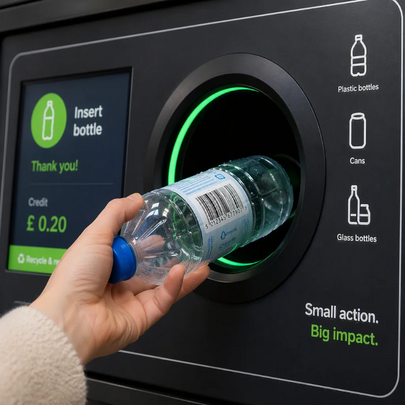
Many retailers will need to operate return points where consumers can return eligible containers and reclaim their deposits, either manually or through a reverse vending machine.
Return point operators will receive a Return Handling Fee to help cover costs including equipment, storage, staff training and space. The fees are currently set at:
- 3p per container for manual return points
- 5p per container for the first 225,000 containers handled each year by an automatic return point
- 1.3p per container for automatic returns above 225,000 containers a year
Exchange for Change is also making £60 million available to help up to 10,000 qualifying independent retailers install reverse vending machines.
Grants of £6,000 per site will be paid in three annual instalments of £2,000.
The criteria for return point exemptions have also been extended. Some smaller urban and rural retailers may be able to apply based on their sales area. Applications may also be considered where there is sufficient alternative provision nearby or where stores face challenges involving access, utilities or restrictions associated with heritage or listed buildings.
Retailers should check the full criteria before assuming they qualify for an exemption. They can also take part in the readiness survey to help identify where further support is needed.
Reverse vending machine testing is under way
Exchange for Change is testing reverse vending machines ahead of publishing its first list of certified models, which it expects to make available in early October 2026.
Retailers considering an automated return point should review the published specification and certification process when speaking to suppliers. They should avoid committing to equipment without checking that it will meet the scheme requirements.
Exchange for Change has also worked with Coca-Cola Europacific Partners and Special Olympics Great Britain on an accessibility trial at the National Summer Games in Birmingham. Feedback from the trial will help identify potential barriers and inform work to make the scheme clear and straightforward for consumers to use.
Product identification remains part of the wider plan
Exchange for Change has already confirmed that existing barcodes on products entering the scheme will need to change and be registered.
Our previous update looked in detail at what this means for product identification, Global Trade Item Number allocation, multipacks and products sold across several markets.
As the one year countdown approaches, businesses need to make sure these changes form part of a wider DRS implementation plan rather than treating them as a standalone packaging task.
Product identification decisions will need to be coordinated with packaging artwork, product data, production schedules, retail systems, registration and plans for managing existing and replacement stock.
What businesses should do now
DRS will affect organisations in different ways, but producers and retailers can already take practical steps to prepare:

- Confirm who is responsible for DRS within the organisation
- Identify the teams and business processes that will be affected
- Review products, packaging formats and routes to market
- Assess artwork, print, production and technology lead times
- Map dependencies on retailers, suppliers and solution providers
- Identify which decisions can be made now and which depend on further guidance
- Make sure GTIN and barcode changes form part of the wider plan
- Review the latest Exchange for Change guidance regularly
Preparation is likely to require input from commercial, product data, supply chain, finance, technology, packaging and regulatory teams. Bringing those teams together now will make it easier to identify gaps and manage dependencies.
How GS1 UK can help
Exchange for Change is responsible for operating DRS and setting its scheme requirements. Questions about product scope, registration, fees, return points and exemptions should be directed to its team.
GS1 UK can support members with the product identification and barcode standards that form part of their preparation. This includes guidance on GTIN allocation, barcode implementation and identifying products consistently across the value chain.
The one year countdown begins on 1 October 2026. Businesses should use the coming weeks to review what has been confirmed, establish clear internal ownership and develop a coordinated plan for the work ahead.
If you are preparing for DRS and need support with your GTINs, barcodes or approach to product identification, get in touch today.


