
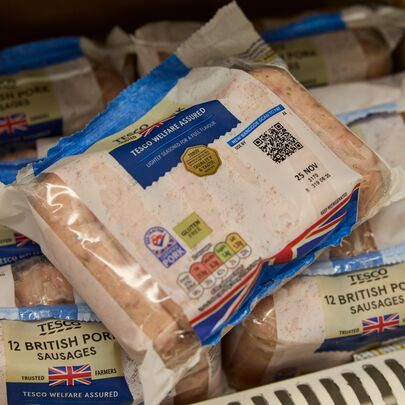
Cranswick is a vertically integrated food company specialising in pigs and poultry that has set clear priorities around sustainability and the reduction of food waste.
In partnership with Tesco and GS1 UK, the business has introduced variable QR codes on pack to improve transparency across the supply chain and help reduce food waste.
The decision to adopt QR codes powered by GS1 reflects a broader commitment to digital innovation. If people on the line, in distribution and in store can see the same accurate information at the right time, more food reaches shoppers at its best, and the supply chain becomes smarter in the process.
On high-speed fresh food lines, a QR code powered by GS1 is not decoration. It is how every pack says what it is, when it should be used and where it belongs.
Why this matters now
Consumers increasingly expect clear, trusted product information and retailers want better date visibility to rotate stock before it expires. A linear barcode can only hold one piece of information, a Global Trade Item Number (GTIN). By contrast, a QR code powered by GS1 holds multiple data points, both offline and online, and can be read at the till, by a scanner, or by a smartphone.
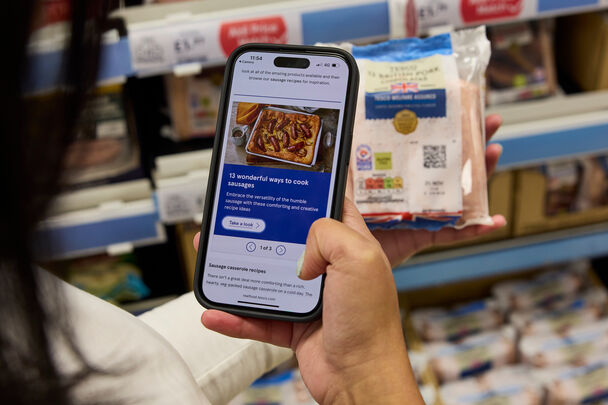
QR codes powered by GS1 link a product’s Global Trade Item Number (GTIN) to live content and operational data so one scan can serve store teams and shoppers alike. The same symbol can be read at point of sale as well as by a phone, unlocking new possibilities.
Capturing use-by and batch data gives earlier signals about what needs attention and creates a foundation for future experiences such as allergen information, sourcing details and recycling guidance.
This is a practical step towards less waste and better stock management, built on open standards rather than proprietary links.
Where Cranswick began
Cranswick made a deliberate choice to move early on next-generation barcodes, starting small to prove the model before committing to scale.
The team ran a gap analysis and a proof of concept at one of their production sites, selecting Tesco garlic and herb ham as the first product. The goal was to prove that a dynamic, scannable code could be printed at speed, stay consistently readable and connect to live data in existing systems. The work set the method for controlled scale up.
From there, the approach expanded to more lines with clear measures on speed, changeovers and consumables, so every decision about scale was based on evidence rather than assumption. From the outset, the programme sought to understand real production impacts.
The team tracked line speed, changeover time and thermal ribbon usage in parallel with code quality, so the trade-offs were visible as more lines came on.
How the approach took shape
Cranswick’s success rested on three key decisions: collaboration with solution providers, the use of dual coding to reduce risk, and a commitment to standards-based implementation.
Collaboration on the line: Cranswick worked with equipment and verification specialists to fit QR into fast packing environments. The team engaged a number of partners across the eco system to integrate coders and verification with existing lines, while Tesco and GS1 UK acted as technical partners and sounding boards through trials and refinements.

Dual coding to reduce risk: To reduce operational risk in the first phase, the team used dual coding. The dynamic QR code appeared on the front of pack while a linear barcode remained on the back. This provided resilience while settings were tuned and people trained, without delaying the transition to QR codes powered by GS1 on the front.
Standards-based approach: The team built on the GS1 Digital Link standard, which structures the web address inside the QR to include the GTIN and can also carry attributes like batch and expiry when needed. That means the same symbol is useful to tills, scanners and phones, and the destination content can change without reprinting packaging.
What it is delivering
The early benefits are operational and clear. Batches and use-by dates are now visible in a shared way across the supply chain, which helps with stock rotation and the reduction of waste. Real-time monitoring supports a cleaner flow of product information between manufacturer and retailer.
The programme has created a strong base for further digitalisation, opening up exploration of new use cases including electronic tagging and spoilage monitoring. Cranswick has received positive feedback from Tesco since launch.
These outcomes align with what UK retail pilots have been testing. By capturing date and batch data, teams report better visibility of items nearing expiry and a stronger foundation for consumer information when brands are ready to activate it.
What comes next
Cranswick plans to expand QR codes powered by GS1 across more product categories. The focus will remain on measuring line speed, changeover time and consumables alongside gains in transparency and rotation, so scale protects both performance and product quality.
The roadmap also includes exploration of additional GS1 standards and where they could add value as adoption broadens.
The wider picture for suppliers
For fresh suppliers watching major retailers test next-generation barcodes, Cranswick’s approach offers a practical blueprint. Here are five key steps:
- Start with one line and a tight scope. Prove the model works before committing resources to scale.
- Make the ERP the authority for print content. A single source of truth prevents inconsistencies across the supply chain.
- Pair printing with verification so problems are caught in production, not in store. Real-time quality checks protect both speed and reliability.
- Use dual coding early to reduce risk and minimise operational disruption during the transition.
- Use GS1 design and implementation guidance so symbol size, placement and syntax decisions are made once and made right. This ensures compatibility across systems and trading partners.
QR codes powered by GS1 are fundamentally different from ordinary QR codes. The GTIN sits inside a standardised link, making one scan a gateway to trusted data for operations and consumers alike. Content can evolve without the need for new packaging runs, providing flexibility as new use cases emerge and standards develop.

