April 13, 2026 Industry news
At the GS1 Global Forum, Roshni Shah and Sophie Christie shared two years of practical lessons from live QR code pilots in one of the UK’s most complex retail environments.
Roshni, engagement manager for the QR programme at GS1 UK, and Sophie, who leads supplier enablement for QR codes at Tesco, have worked closely since the pilots began. Their session set out what it really takes to be QR ready, from getting the GS1 Digital Link standard right to printing inline at line speed and verifying every pack, so that others can move faster.
Why Tesco is taking QR seriously
Tesco scanned its first linear barcode in 1974. For 50 years, the technology did its job brilliantly. But the linear barcode can only do so much. It cannot carry an expiry date, batch code or URL that would unlock a new generation of stock management, waste reduction and consumer engagement capabilities. Tesco trialled double-stacking barcodes in 2018 to capture use-by data, but it was not the right solution at the time.

Roshni Shah and Sophie Christie at the 2026 GS1 Global Forum
As technology, standards and retailer infrastructure matured, a better answer emerged.
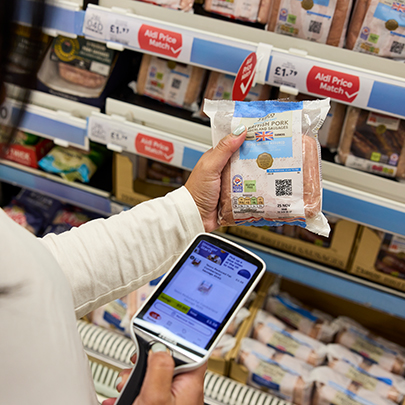
QR codes powered by GS1 provide a single symbol carrying the Global Trade Item Number (GTIN), expiry date, batch code and a URL, scannable at the till, in the warehouse and on a customer’s phone.
The business case is clear. Expiry date data sharpens ordering algorithms and reduces waste. Batch codes enable targeted recalls rather than blanket withdrawals.
The URL gives Tesco a direct channel to share the provenance and quality behind every product.
Tesco’s store technology is already ready, with QR codes scannable at every till. With three QR-only products in store at the time of the panel, the direction of travel is set.
The cost of getting it wrong
Roshni opened the technical part of the session by quoting a phrase that has become something of a watchword for the QR programme. In the words of Phil Archer, GS1’s web solutions director: “Just because you can scan it with your phone doesn’t mean it will scan at point of sale.”
The numbers bring this point to life. If there are one million fresh produce scans at tills every day and a poorly printed QR code adds just half a second to each one, that is 50,000 additional hours of checkout time in a year. One extra second becomes 100,000 hours. Two seconds reaches 200,000 hours, equivalent to more than two million pounds in additional labour costs at UK minimum wage.
These are conservative estimates but, as Roshni noted, “a bad QR code isn’t just a bad QR code. It’s millions of pounds that are lost, hundreds of hours added onto things. It’s frustrated colleagues, angry customers and a queue that becomes ten times longer than it normally would.”
This is a central theme that runs through everything Tesco and GS1 UK have learned. Quality is not a nice-to-have. It is the thing that determines whether the entire programme delivers on its promise.
Getting the data right
The GS1 Digital Link standard makes interoperability possible. By following it, a single on-pack QR code can carry the GTIN alongside the other identifiers a retailer needs and resolve correctly whether it is scanned by a phone or a retail system. In practice, that means keeping a close eye on four things.

Roshni, engagement manager for the QR programme at GS1 UK
First, keep the URI short. The longer it is, the denser the code, and the harder it becomes to print and scan reliably.
Second, GTINs must be 14 digits. If yours is 12 or 8, pad it with leading zeros.
Third, application identifiers must be correct, or the scanner does not know what it is reading.
Fourth, expiry dates must follow the YYMMDD format specified in the standard. Entering the date back to front can block a perfectly good product at point of sale.
Use uppercase for the domain name in the URI to reduce data density further.
None of this is technically demanding, but errors that slip through are often invisible until something fails at the till.
Four print quality watchouts
Print quality failures typically cluster around four issues: contrast and reflectance, quiet zones, modulation and curved or uneven surfaces.
Modulation, where ink bleeds from the dark modules into the white spaces, is the most common problem. It is affected by line speed, the X dimension of the code, DPI settings and heat. There is no single fix. It requires working closely with suppliers and solution providers to understand the specific tolerances of each line.
Tesco’s trials were deliberately cross-category and cross-substrate, designed to understand how QR codes perform across the full range of packaging environments. Paper labels, wineglass labels and glued labels performed best at the till, due to their low reflectance, good contrast and space for a clean quiet zone. Flow wrap and flexible bags performed worst, partly because shiny surfaces create reflectance problems and partly because product visible through translucent packaging can distort the code. Cartons and sleeves sat in the middle, where consistency of presentation on the line was the main variable.
The twist is that flow wrap, the hardest substrate to scan, is often the easiest to print on consistently. Paper labels, where scanning is most reliable, tend to show more print variation, and the labels are often small enough that size becomes a genuine constraint. Where QR codes on challenging substrates are already in store, Tesco has made them slightly larger to ensure they scan at the till as quickly as a linear barcode.
The categories that remain unsolved
Some categories present challenges that the industry has not yet fully resolved. Milk lines run at 200 units a minute.

Sophie Christie, supplier enablement lead in Tesco's quality team
Bananas arrive from suppliers ranging from high-specification UK packing houses to small family farms in Guatemala, each with very different technical capabilities.
Products that go through a freezing process must be printed either before or after a deep-freeze process that can compromise ink.
Bread is bagged before the use-by date is applied, so the QR code must be printed onto a soft, uneven surface.
These are not edge cases. They represent a significant part of most retailers’ ranges and solving them will require collaboration across the industry.
Verification: the safeguard that makes the rest worthwhile
A QR code on pack that has not been verified is a liability rather than an asset. The pilots made that clear quickly.
Two types of verification are currently in use. Offline verification, using ISO-graded equipment, is highly accurate and produces diagnostic reports to help identify the root cause of print problems. The limitation is sampling frequency. If a line is checked every 30 minutes, half an hour of defective product can leave the site before anyone knows there is a problem.
Inline verification checks every code in real time and stops the line immediately when a threshold of failures is reached. Nothing defective leaves the site. But current inline solutions are not ISO-graded, which means they cannot offer the same confidence about how a code will ultimately perform at the till.
The state the industry is working towards combines both: offline grading providing the quality benchmark, inline checking providing the real-time safety net. Solution providers developing inline verification technology have a clear signal from the market about what is needed.
What this means for the industry
Sophie was direct about where the pressure now sits. Line speed is non-negotiable: “We absolutely cannot allow our suppliers to reduce their line speed and put that on them and reduce their capacity.” Substrate is rarely something that can be changed for packaging reasons alone. So, the pressure falls on technology to keep pace with the physical realities of production.

Sophie and Roshni addressing the audience at at the 2026 GS1 Global Forum
Three priorities emerged from the session. The first is enabling inline verification that matches the accuracy of ISO-graded offline checks. The second is reducing QR code size without sacrificing scan performance, something Sophie flagged directly: the code is “currently taking up quite a lot of important real estate on the front of pack.” The third is finding workable solutions for the categories that remain genuinely difficult to print on at speed and at scale.
None of these will be solved by any single organisation. Both Sophie and Roshni closed by acknowledging that the learning from two years of pilots has only been possible because of the people who shared it. As Roshni told the room: “Without you, we would not have this knowledge.”
That spirit of openness and collaboration is, in many ways, what the whole session was about. The technology, the standards and the business case are all in place.
What takes QR codes from pilots to full rollout is everyone in the ecosystem working through the hard problems together.