
What does SSCC stand for?
SSCC stands for Serial Shipping Container Code.
What is an SSCC used for?
SSCCs are used for supply chain tracking and traceability. They allow for pallets, containers and other logistics units to be tracked through supply chains, from origin through to destination.
SSCCs are also used in advanced shipping notices, allowing suppliers to share detailed information about goods with retailers via EDI (Electronic Data Interchange) - more on this later.
How does an SSCC work?
An SSCC is a unique 18-digit GS1 identification key that provides a unique identifier for a logistical unit such as pallets, cases or parcels. They are printed on GS1 logistic labels, and used to identify and track a specific unit as it moves through storage, distribution, and transport.
SSCCs are created from GS1 company prefixes. Each SSCC is constructed from:
- An Extension Digit
- A GS1 Company Prefix
- A Serial Reference
- A Check Digit
When represented as a barcode, the SSCC is encoded using GS1 Application Identifier (00). Scanning the barcode captures the SSCC, letting systems recognise and reference the specific logistic unit it pertains to. This lets the SSCC function as a reference key that can be linked to information about the unit in business systems and supply chain processes.
SSCC code structure explained
SSCCs contain an Extension Digit, a GS1 Company Prefix, a Serial Reference and a Check Digit. Here we explain each in more detail.
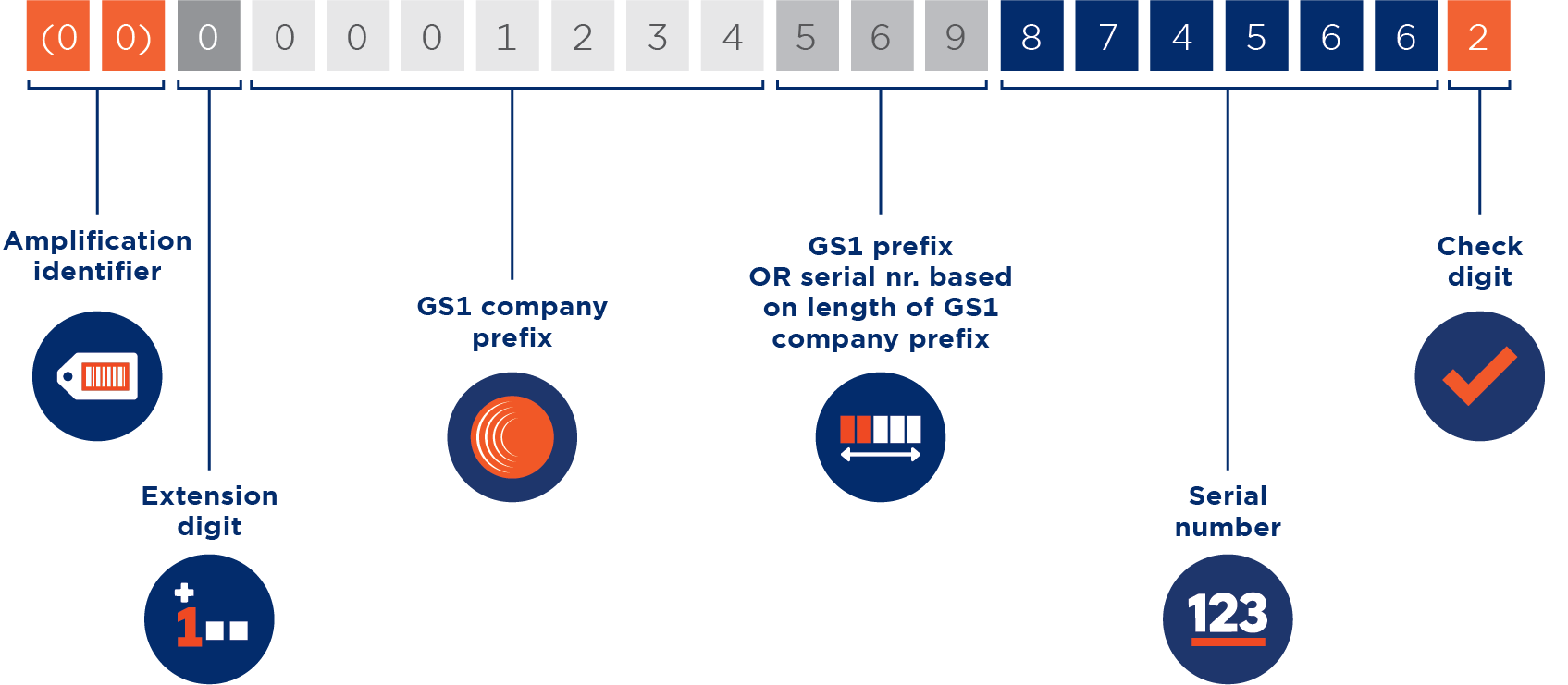

Extension Digit
Extension Digit is any number from 0-9, used to increase the number of SSCCs that can be created.

GS1 Company Prefix
GS1 Company Prefix is a 6-11 digit number allocated when joining GS1UK, available in My Numberbank

Serial Number
A Serial Number is a unique number assigned by your company to each logistic unit - chosen and allocated sequentially or according to your own system

Check Digit
Check Digit is a digit calculated from the previous 17 via the same calculation method as other GS1 identifiers, to ensure validity of the full SSCC
How is an SSCC encoded on a label?
An SSCC is encoded in a GS1-128 barcode using an Application Identifier (00). The Identifier tells the scanner that the following data is an SSCC, and the barcode includes:
- AI (00): a two digit prefix signalling that this is an SSCC
- The 18-digit SSCC: constructed per the previous section
- The barcode symbol: the black and white bars that represent that data visually
Want to get a deeper understanding of our standards for SSCCs and logistic labels?
GS1 UK provides our members with free access to our GS1 Print service where you can generate SSCCs and logistics labels for your shippers.
What is the difference between an SSCC and a GTIN?
A GTIN identifies an individual product, an SSCC identifies the pallet, shipper, or logistics unit carrying those products. For example: in a pallet of 48 cases of a product, each product has its own GTIN, while the pallet as a whole has an SSCC.
Benefits of using SSCCs in your supply chain
Access to a standardised method for uniquely identifying logistics units
Simpler tracking and tracing of your products through the supply chain, all with one label
Unique identification for standard and non-standard pallets
Minimised labelling costs through the use of global standards
The ability to provide information about the contents of each unit
Improved control procedures in warehousing and distribution
A consistent link with EDI business messages
Automation and efficient handling of transport units and their contents
Increased speed of processing deliveries
How to create an SSCC with GS1UK
When you join GS1UK you receive a Company Prefix. GS1 UK members can use GS1 Print to generate SSCCs and logistics labels for no additional cost.
Take a look at our membership options to get started.
SSCC FAQs
Here are answers to some common SSCC questions. If you have more questions, get in touch.
Yes, SSCCs can be reused 12 months after they were last allocated. The company assigning the SSCC is responsible for ensuring its uniqueness while in use. But in reality, a GS1 Company Prefix can generate so many SSCCs that reusing is not necessary.
Yes: to create your SSCCs you need a GS1 Company Prefix, which is allocated when you join GS1UK.