March 11, 2026 Industry news
With 1 October 2027 steadily approaching, the UK deposit return scheme is no longer a distant prospect it is an immediate operational priority.
The UK Deposit Management Organisation, now trading as Exchange for Change, has appointed its senior leadership team, published technical specifications and launched an intensive business engagement programme.
This update covers the latest milestones, critical decisions still pending and the specific actions businesses must take now to prepare successfully.
Recent milestones: building momentum in early 2026
Exchange for Change has made significant progress since May 2025 when the DMO was appointed. Key recent developments include:

- Brand identity and logo unveiled: earlier this year, the DMO unveiled the ‘Exchange for Change’ brand and a new logo that will appear on all in-scope containers and return points from October 2027 onwards. This will become the single, recognisable identifying symbol across the scheme.
- Senior leadership appointed: chief executive Russell Davies and a complete senior team including Chief operating officer Andrew Smith, Corporate affairs director Kate McFarran and Legal director Rehan Akram are now leading the scheme administrator. This team brings significant supply chain, logistics and executive leadership experience.
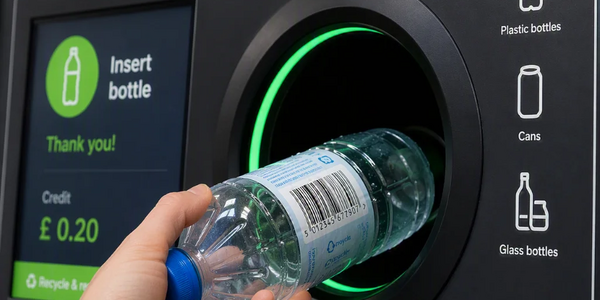
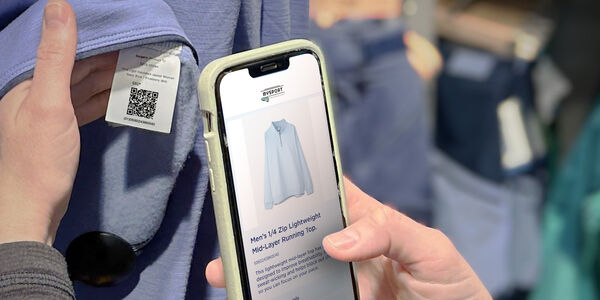
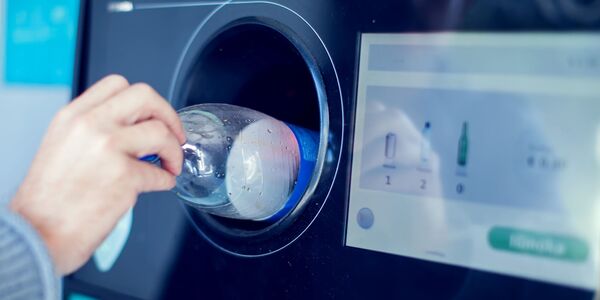
- Technical specifications released: Exchange for Change has published the first Reverse Vending Machine (RVM) specifications, giving producers and suppliers the detail they need to start planning label readability tests with pilot equipment. The specifications state that RVMs must read both linear barcodes (EAN‑8, EAN‑13, UPC) and 2D codes (QR and Data Matrix), supporting the move towards on‑pack 2D where adopted. Business engagement programme launched:
- The ‘DRS 101’ webinar series: began in February and will run throughout the year. These sessions provide producers, retailers, wholesalers and hospitality operators with foundational understanding of their DRS responsibilities and obligations.
Wales: charting a different course
Wales will launch its DRS on the same date as England, Scotland and Northern Ireland (1 October 2027) but has chosen a distinctly different regulatory approach that producers and retailers must understand clearly.
- Glass is in scope from day one: Unlike the rest of the UK, Wales will include glass bottles in its scheme immediately. However, a four-year transition period (October 2027 to October 2031) applies, during which glass containers will carry zero-pence deposits and have no labelling requirements. This gives producers time to adapt to full glass inclusion from 2031.
- Reuse is embedded structurally: Wales has embedded mandatory reuse targets directly into its DRS framework. Targets are measured per container rather than by weight, with key milestones in 2031, 2035 and 2040. The Welsh Government is also running a large-scale reuse trial with industry ahead of launch, drawing on international evidence where bottles circulate eight or more times in mature DRS markets.
- Separate Welsh DMO: A dedicated Welsh Deposit Management Organisation is expected to be appointed in March 2026, following applications closing in January 2026. Producers serving Wales must engage with both Exchange for Change and the Welsh DMO.

If you sell drinks into Wales, you will need to meet both UK‑wide requirements and additional Welsh‑specific rules.
For PET, aluminium and steel, the schemes will operate through a single interoperable system with shared registration and reporting.
However, Wales’ inclusion of glass from day one introduces significant extra complexity at point of sale and across supply chains. Cross‑border compliance planning must start now.
Critical decisions coming in spring 2026
Exchange for Change will finalise several operational parameters in spring 2026. These decisions will directly affect your labelling, pricing and compliance strategy:
- Deposit level: not yet confirmed. Public guidance indicates this will be set by the scheme administrator and regulators closer to launch, with Wales required to align deposit levels for plastic and metal under UK‑wide interoperability conditions. For context, Scotland previously legislated a 20p deposit.
- Producer fee structure: how producers will be charged for scheme administration remains to be clarified.
- Complete labelling guidance: Exchange for Change has published the approved scheme logo regulatory requirements, with downloadable artwork files for producers to use now. Further packaging and labelling guidance, including detailed specifications and any exemptions, is expected during 2026. The RVM specification confirms that machines must read both linear barcodes and 2D codes (QR and Data Matrix), which should be factored into label planning.
- Return point network design: specifications for return point infrastructure and the geographic network to serve all consumers are still being finalised.
What your business must do now
For producers
Register for scheme engagement: attend Exchange for Change webinars and join industry working groups now. Early engagement ensures your voice shapes operational decisions.
Ensure GS1 compliance: all in‑scope containers will need a machine‑readable identifier so return points can recognise them within the DRS. To prepare, we recommend that each product carries a GTIN and a quality‑tested barcode in line with GS1 standards. If you need GTINs, you can get these in My Numberbank.
Plan labelling trials: work with packaging suppliers and printers to incorporate the Exchange for Change scheme logo and the required machine‑readable code. With RVM specifications already published and early deployment beginning in 2026, producers will need to test their packaging for compatibility well ahead of launch.
Assess your product portfolio: identify which SKUs are in scope (PET, aluminium, steel, 150ml–3 litres). Even exempt products (under 5,000 units annually) must be registered and reported.
Plan for Wales separately: if you sell into Wales, map the implications of the separate DMO, glass inclusion and reuse requirements now. Costs and complexity will differ materially.
For retailers

Procurement and infrastructure: if you operate supermarkets or large retail spaces, begin RVM procurement discussions now. Plan placement, size, maintenance contracts and fallback manual return capacity.
Point of sale and logistics: update POS systems to charge and track deposits. Plan space for container storage, cleaning and daily processing logistics.
Staff training: plan training for all staff on deposit charges, returns processes and RVM operation.
Small retailers (under 100m²): in many cases, smaller stores may not be required to host a return point. You should still plan to apply the deposit at point of sale and consider how you will inform customers about local return options.
The role of GS1 standards
GS1 standards play a key role in enabling the systems behind the deposit return scheme.
Global Trade Item Numbers (GTINs) provide unique product identification, helping to ensure that drinks containers can be correctly registered and recognised within the scheme. Barcodes such as EAN‑13, EAN‑8, UPC‑A or UPC‑E, along with QR codes powered by GS1, allow return point technology including Reverse Vending Machines to scan containers and confirm they are in scope.

GS1 EDI standards also support accurate and consistent data exchange between producers, retailers and Exchange for Change, while Global Location Numbers (GLNs) offer a standardised way to identify return points and other locations across the wider DRS network.
To prepare effectively, producers should ensure all in‑scope products carry valid GTINs and that barcodes meet appropriate quality standards to support reliable scanning.
As the UK moves towards wider adoption of 2D barcodes, including QR codes powered by GS1, it is important to confirm that any 2D codes used encode the correct GTIN and are compatible with emerging DRS labelling requirements.