June 02, 2026 Industry news
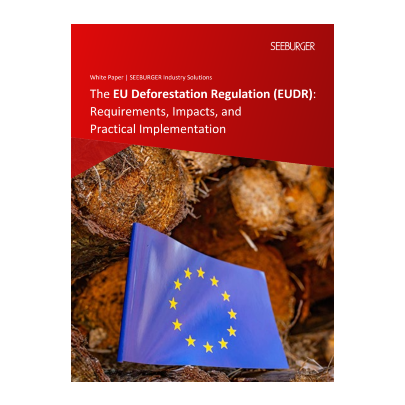
GS1 UK partner SEEBURGER has produced a white paper exploring the EU Deforestation Regulation and what it means for businesses.
From 30 December 2026, companies placing in-scope products on the EU market or exporting them will need to demonstrate that those products are deforestation-free, produced in line with local laws, and supported by a due diligence statement. For many organisations, that is less about interpreting policy and more about how they manage and evidence what is happening across their supply chains.
It is worth being clear about what EUDR is asking businesses to do in practice. This is not simply a documentation exercise. Companies need to link products to their origin, including the country of production and, in many cases, the specific plots of land involved. They also need to assess risk, maintain supporting evidence and submit due diligence statements before products can be placed on the market or exported. That shifts the focus from individual records to something much more structured and repeatable.
Who is affected?
The regulation applies to companies that place in-scope commodities or products on the EU market for the first time, make them available within the EU, or export them.
Those placing products on the market face the most extensive requirements. They need to demonstrate that products are deforestation-free and compliant with local laws, supported by robust due diligence.
Organisations that process or resell those products are expected to maintain and pass on the relevant information, ensuring traceability is preserved as products move through the supply chain. In practice, that means capturing the right data and keeping it aligned across trading partners.
Why data becomes critical
One of the key points the white paper raises is that compliance depends on more than collecting information. Data needs to be complete, consistent and connected across systems and organisations.
EUDR-relevant information typically sits in different places, from ERP systems and supplier portals to logistics platforms and document repositories. Bringing that together in a way that supports traceability and audit is a significant challenge.
In practice, this often comes down to whether products, suppliers, locations and supporting information are referenced consistently across systems. If data is captured or described differently between trading partners, it becomes harder to connect product data to origin, movement and supporting documentation in a way that stands up to scrutiny.
That challenge does not sit with one organisation alone. It depends on alignment across suppliers, partners and systems throughout the supply chain.
The role of standards and interoperability
The report highlights the importance of structuring and exchanging data consistently across supply chains.
While EUDR does not mandate the use of specific standards, approaches such as GS1 can help organisations identify products, locations and trading partners in a consistent way, so that information is understood in the same way across different organisations and systems.
In practice, this is about having a shared way to identify, capture and share supply chain data. GS1 standards provide a common framework that allows organisations to reference the same products, locations and partners consistently and connect that information across systems. This makes it easier to link product data to origin, movements and supporting documentation in a structured and auditable way.
That kind of shared foundation becomes increasingly important where multiple organisations need to align on the same data to support traceability, due diligence and reporting. Without that alignment, even well-managed supply chains can struggle to demonstrate compliance clearly and consistently.
As with other areas of digital transformation, this is not about a single system or solution. It is about making sure data can move between partners and platforms without losing meaning or creating ambiguity.
While standards provide the common language for EUDR-relevant data, organisations also need the ability to operationalise that data across their existing systems and partner networks.
This is where integration becomes critical. Product, supplier, origin, geolocation and documentation data often sits across ERP systems, supplier portals, logistics platforms, document repositories and external trading partners. To support due diligence at scale, that information needs to be connected, validated and made available in the right business context. Integration helps turn standards-based data and distributed system information into a usable, auditable process for traceability, reporting and compliance.

From compliance to operational readiness
SEEBURGER’s white paper is clear that EUDR is as much an operational challenge as it is a regulatory one.
Meeting the requirements at scale means moving beyond disconnected records and towards a more structured approach to managing supply chain data. That includes improving data quality, aligning information across trading partners and putting in place processes that can stand up to audit and regulatory scrutiny.
For organisations preparing for 2026, the focus is less on individual deadlines and more on building the long-term capability to manage and share reliable supply chain data at scale.