

The Turmeric Co started long before it had a name, a label or a route to market.
Founder Thomas “Hal” Robson‑Kanu, a former Premier League and Wales international footballer, traces it back to a decade of research led by his father, after Thomas spent two and a half years in and out of surgery and living with pain and inflammation.
The starting point was not a lack of promising ingredients, but how difficult it was to use them consistently. What Thomas and his father kept coming back to was the importance of repeated use over time, something existing products did not make easy in practice.
His father began sourcing whole ingredients and working out how to turn them into something that could be taken regularly, not occasionally. Over time, that kitchen process became a shot format the family could rely on. Thomas describes using the blend consistently and the outcome, for him, was clear. “After six weeks of using this blend, religiously, after two and a half years of pain and inflammation, I was completely pain free,” he says.
From personal recovery to a product worth sharing
The next step was not a business plan. It was other people asking for the same thing.
Thomas says the blend became his “secret weapon” throughout his football career. It was not only about getting back on the pitch, but about recovering quicker than teammates during intense periods and staying well through winter months when illness was common in the changing room.
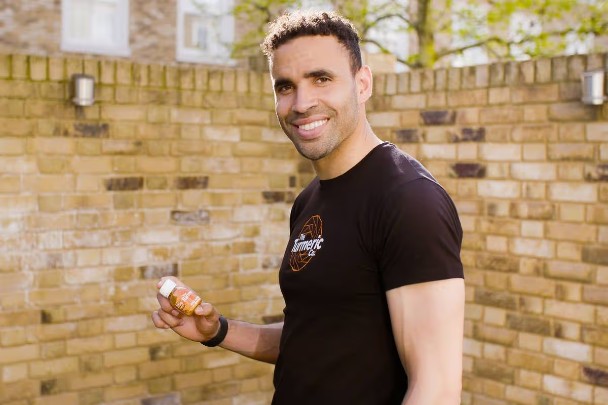
Thomas “Hal” Robson‑Kanu
As friends and family began using it too, a pattern emerged. People were not looking for a one-off fix. They wanted something they could take consistently and feel a difference over time.
By 2018, Thomas and his father felt there was a gap worth addressing. The functional shots category was growing, but he believed too many products on shelf fell short of being genuinely functional. Thomas noticed there were many shortcuts across the market, including juice bases used as cheaper fillers and processes such as pasteurisation, which he felt undermined what they were creating at home.
So they launched The Turmeric Co direct to consumer in 2018, bringing the family recipe to market in a format designed around repeat use.
Becoming the manufacturer before building the brand
Most founders reach the point where they find the right production partner. The Tumirc Co’s story goes the other way.
Thomas says he approached leading beverage manufacturers in the UK and Europe and asked them to replicate a homemade process using whole raw ingredients and multiple extraction steps. “They basically all looked at it, laughed and shut the door in our faces,” he says. The process was too complex, the ingredients awkward to handle and it did not fit the way most factories were set up.
The result was the defining decision behind the business
“We realised very quickly that in order to bring this blend to market, we first had to become a manufacturing business before becoming a brand,” he says.
At the time, he was still playing in the Premier League. Alongside his football career, he worked with a machine manufacturer to develop bespoke equipment capable of replicating the kitchen process at scale. He describes a six-to-nine-month period to land on the right machinery and have it built.
Then came the question of where to put it. Thomas says they flattened a number of garages behind his father’s house in London and set up a small unit to begin producing.

The turning point: early demand and proof beyond the founders
The first real validation came quickly. Thomas says that within four weeks of selling their first product, they received their first “life changing customer testimonial”, which helped confirm that the product had relevance well beyond elite sport.
From there, the challenge became scaling without compromising the process that made the product distinctive. Within around two years, production had grown to 10,000 shots a week, before the business hit capacity and needed to plan its next phase properly.
Scaling with discipline: standards, research and operational readiness
A defining feature of The Turmeric Co’s growth has been its emphasis on discipline and proof. During a period where production capacity limited expansion, Thomas describes investing in consumer insight, commissioning independent clinical research and building an innovation pipeline.
Nottingham Trent University has since reported on a study involving elite professional footballers, where consuming a 60 ml turmeric drink twice a day supported quicker return to baseline soreness and blood markers of inflammation compared with a control group, with supplements provided by The Turmeric Co.
On the operational side, the business moved from a small early site to a significantly larger headquarters designed to support future scale and high food safety standards, housing production, packing and R&D.
Getting retail ready and why identifiers matter
Moving into retail introduced a new layer of complexity, from packaging formats and outer cases to pallet specifications, forecasting and shelf readiness.
Thomas describes retail as “a real steep learning curve”, involving a shift in mindset as well as systems. He talks about understanding routes to market, supply chain planning and the realities of competing for shelf space, alongside learning how different retailers operate.
Their route into Sainsbury’s began with an invitation for Thomas to speak about his journey, followed by discussions with the buying team and a launch plan. The Turmeric Co launched in Sainsbury’s in October 2023.
It was also at this point that GS1 standards became operationally important. As packaging expanded beyond single units to include full bottle packaging, outer cases and pallets, Thomas says the business needed to ensure everything was scannable and retail ready. “We had to go down the route of GS1 in terms of barcodes,” he explains, as part of preparing the business for scale.
Advice for fellow founders
Asked what he would pass on to another founder, Thomas does not talk about hacks or shortcuts. He focuses on the fundamentals that hold up when everything gets busy.

First, culture. “Define culture and core values,” he says, and “only hire people who are aligned with those”, something he says he “had to learn that the hard way”.
Second, maintaining a long term view. He describes how easy it is for founders to stay in the weeds, and how valuable it can be to step back and plan against the bigger vision rather than only the immediate problems.
Finally, building a business that is not dependent on one person. “Work on working yourself out of the business,” he says. For him, that means people, process and governance, building robustness so decisions move without always needing the founder in the room, and freeing leaders to work on the business, not just in it.